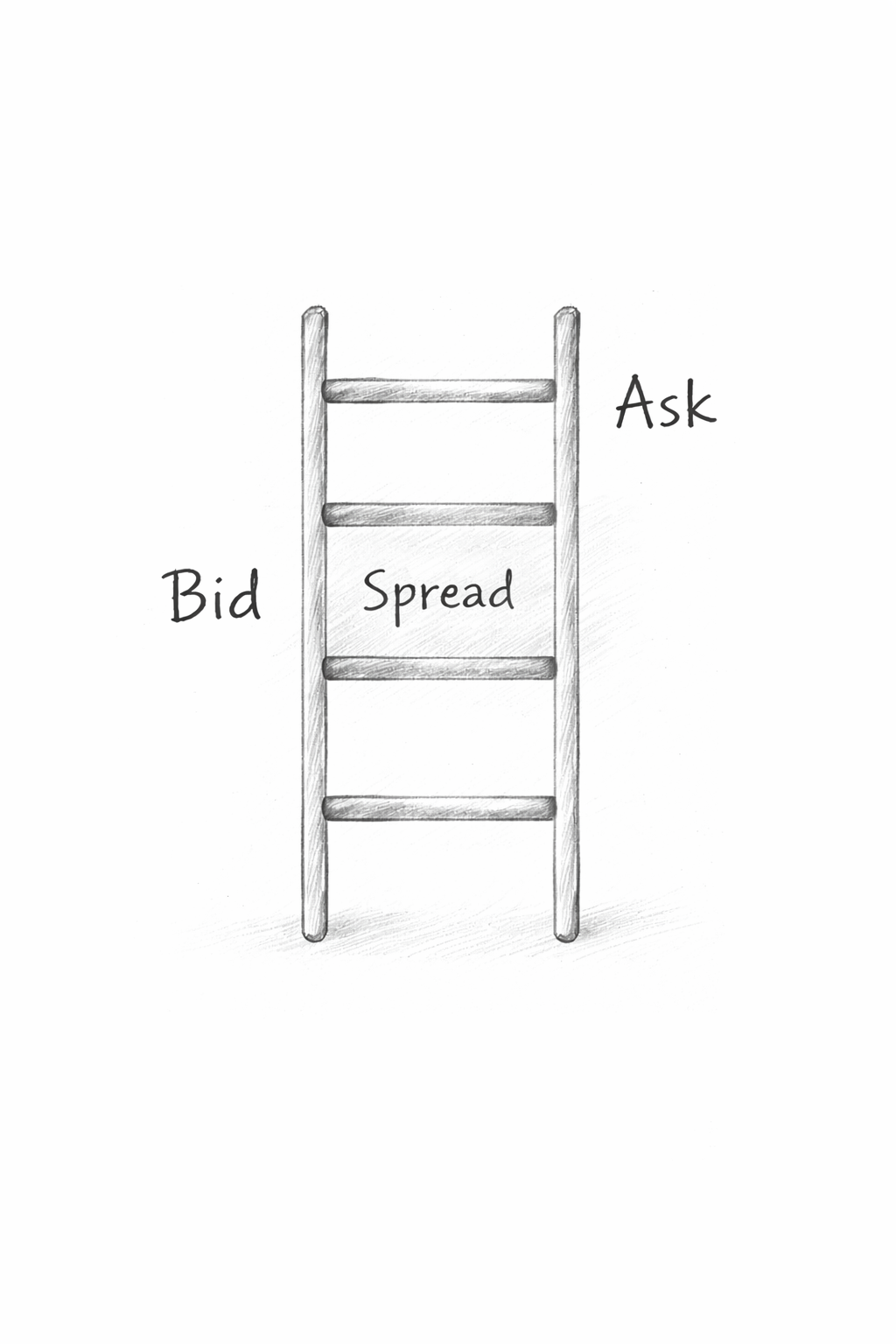
If you’ve ever tried to buy or sell stocks, you may have noticed that there isn’t a single fixed price. Instead, you’ll see two prices: the bid price and the ask price.
Understanding the difference between the stock bid-ask prices is crucial for making informed trading decisions and managing costs effectively. The bid price is the highest amount a buyer is willing to pay for a stock. The ask price is the lowest amount a seller is willing to accept. This type of cost awareness sits at the heart of the Financial Freedom Foundations, where small inefficiencies quietly compound over time.
The difference between these two is called the bid-ask spread.
What Are Stock Market Bid-Ask Prices?
In the stock market, there is no single fixed price at which shares trade. Instead, every stock is quoted with two prices:
The bid price is the highest price a buyer is willing to pay for a stock
The ask price is the lowest price a seller is willing to accept
The difference between the bid price and the ask price is known as the bid-ask spread.
Stock market bid-ask prices exist because buyers and sellers have different expectations, time horizons, and urgency. Trades occur only when those expectations overlap.
Imagine visiting a Sunday market specializing in sweatshirts. Multiple sellers offer the same sweatshirt, but at slightly different prices.
Buyers look for the best deal (ask price), while sellers try to maximize profit (bid price). If a seller’s price is too high, they might not sell anything. If a buyer bids too low, they won’t find a seller willing to accept. In other words, sellers focus on the bid prices (what the buyers are willing to pay), and the buyers focus on the ask price (what sellers are asking).
This is exactly how stock trading works—buyers and sellers negotiate prices, leading to a spread between the highest bid and lowest ask.
Why There Is No Single Stock Price
Many investors assume that the price shown on a chart is the price at which they can buy or sell. In reality, that price usually reflects the last traded price, not the next available price.
Stock market bid-ask prices continuously adjust as new orders enter the market. The bid reflects demand, while the ask reflects supply. The spread represents the gap between them.
This distinction becomes especially important during volatile markets or when trading less liquid stocks.
The Sunday Market Analogy
Imagine visiting a Sunday market where several stalls sell identical sweatshirts.
Some sellers are willing to accept a lower price to sell quickly. Others hold out for a higher price. Buyers browse, compare prices, and negotiate.
Eventually, trades occur when buyers and sellers agree on a price.
This is exactly how stock market bid-ask prices work. Buyers focus on the bid price, sellers focus on the ask price, and the spread reflects the ongoing negotiation between the two.
Why Do Stock Market Bid-Ask Prices Change?
Stock prices move because markets constantly react to new information. Changes in earnings expectations, economic data, interest rates, and sentiment all influence supply and demand. During volatile periods, understanding market mechanics becomes less about optimisation and more about resilience under uncertainty.
Several factors affect the size of bid-ask spreads:
Liquidity
Stocks with high trading volume typically have tighter bid-ask spreads because there are many active buyers and sellers.
Market Volatility
During periods of uncertainty or rapid price movement, spreads often widen as participants demand more protection.
Stock Characteristics
Lower-priced or thinly traded stocks tend to have wider spreads, increasing trading friction. A wider bid-ask spread does not necessarily mean a stock is risky, but it does mean trading it can be more expensive.
How Bid-Ask Spreads Affect Trading Costs
The bid-ask spread represents a hidden trading cost. Bid-ask spreads play a crucial role in determining the stock trading costs and efficiency of different trading strategies.
For example:
A stock is quoted at $49.95 bid and $50.05 ask
A market buy executes at $50.05
An immediate sale executes at $49.95
The $0.10 difference per share is the cost of crossing the spread.
For long-term investors, this cost may seem small. For active traders, repeated exposure to bid-ask spreads can materially impact performance over time.
How to Minimize Bid-Ask Spread Costs
To avoid unnecessary losses, consider these strategies:
- Trade Stocks with Small Bid-Ask Spreads. Higher liquidity stocks have smaller spreads, making them more cost-efficient. Look for stocks with high trading volume.
- Use Limit Orders. Instead of Market Orders
A market order buys or sells immediately at the current price, which could be unfavorable if the spread is wide. A limit order lets you set your desired price, ensuring better control over costs. - Trade During Peak Market Hours – Spreads are usually tighter when markets are most active, typically at the opening and closing of the stock market. I personally wait to see how the day pans out and generally place trades at the end of the trading window.
- Avoid Low-Volume Stocks. Less popular stocks tend to have higher bid-ask spreads, which can lead to higher trading costs.
Market Orders vs Limit Orders
Order type plays a key role in how stock market bid-ask prices affect you.
Market orders prioritise speed and execute at the current bid or ask price
Limit orders allow you to specify the price at which you are willing to trade
Limit orders can help reduce spread costs, particularly in stocks with wider bid-ask spreads or during less liquid trading periods. Neither is inherently better. The key is matching the order type to market conditions and intent.
This idea of matching tools to intent is a recurring theme across the broader Financial Freedom Framework.
Best Times to Trade and Bid-Ask Spreads
Liquidity varies throughout the trading day.
The market open can be volatile as overnight information is absorbed
Mid-session trading often provides more stable bid-ask spreads
The close sees increased activity as positions are adjusted
Many experienced traders prefer to observe early market behaviour before placing trades, reducing the impact of short-term noise.
How Bid-Ask Prices Affect Different Trading Styles
Stock market bid-ask prices affect traders differently depending on their approach:
Day traders and short-term traders
Tight bid-ask spreads are critical due to frequent trading.Swing traders
Spreads matter, but are usually secondary to trade structure and risk management.Long-term investors
Spreads are less critical, though they still influence entry and exit efficiency.
Understanding your trading style helps determine how much attention bid-ask spreads deserve.
Key Takeaways for Stock Market Bid-Ask Prices
The important things to understand are:
- The bid price reflects what buyers are willing to pay.
- The ask price reflects what sellers are willing to accept.
- The bid-ask spread represents a real but often overlooked trading cost.
- Narrow spreads usually indicate higher liquidity.
- Using limit orders and trading during active hours can reduce friction.
Understanding stock market bid-ask prices is not about trading more aggressively. It is about trading more deliberately and efficiently.
Frequently Asked Questions About Stock Market Bid-Ask Prices
What are stock market bid-ask prices in the stock market?
Stock market bid-ask prices are the two key prices quoted for a stock at any given moment. The bid price is the highest price a buyer is willing to pay, while the ask price is the lowest price a seller is willing to accept. The difference between them is called the bid-ask spread.
Why are bid prices always lower than ask prices?
Bid prices are usually lower than ask prices because buyers aim to pay as little as possible, while sellers want to receive as much as possible. The difference reflects supply and demand and forms the bid-ask spread.
How does the bid-ask spread impact trading costs?
The bid-ask spread affects trading costs because investors typically buy at the ask price and sell at the bid price. Wider spreads increase the implicit cost of entering and exiting a trade, especially in less liquid markets.