GenAI, Work, and Financial Resilience
A moment to pause, reflect, and reposition. This reflection sits within the my Financial Freedom Resilience pillar, which explores how people build freedom by staying relevant, adaptable, and shock-resistant over time.
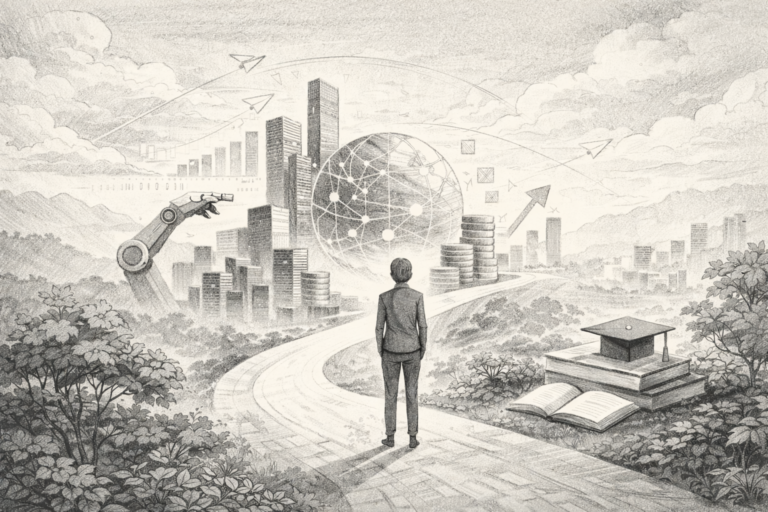
This is not a technical article. And it is not an attempt to turn myFinancialFreedom (MFF) into an AI commentary platform.
This is a pause.
A moment to reflect on something much more fundamental: how Generative AI (GenAI) is exposing where work, income, and careers are resilient, and where they are quietly fragile.
Across conversations with people working in healthcare, marketing, advertising, IT, HR, finance, education, and customer-facing roles, a consistent pattern keeps appearing.
Most people intellectually accept that AI is changing how work gets done, but emotionally assume their own role will remain broadly untouched.
From an MFF perspective, this matters because financial freedom is not built on assumption. It is built on resilience. And resilience is always tested during transitions, not during calm periods.
Why GenAI Is Not a Passing Phase
It is tempting to view GenAI as another productivity wave that will crest and then fade, much like many tools before it. But GenAI is not a feature or a platform. It is a capability layer that sits underneath how modern work is done.
Once the cost of drafting, analysing, summarising, and comparing information collapses, it does not rise again. Organisations do not voluntarily return to slower, more expensive ways of working once speed and scale become embedded in everyday processes.
More importantly, GenAI is being woven into systems, workflows, and expectations rather than used as a standalone tool. When capabilities become infrastructure, they stop being optional. They quietly reshape what is considered normal, efficient, and expected.
From a resilience perspective, this matters because permanence changes the question. The challenge is no longer whether this shift will last, but how individuals position themselves in a world where it does.
Why This Moment Matters for Resilience, Not Productivity
Every generation experiences technologies that promise efficiency. What GenAI does differently is compress thinking work itself.
Drafting, summarising, analysing, comparing, planning, and reviewing are no longer time-intensive activities reserved for specialists. They are becoming background capabilities.
This does not remove work. It repositions where value sits.
From a resilience lens, the key question is not whether AI can do parts of your job, but whether your income and relevance are anchored in activities that remain valuable when output becomes abundant.
Marketing and Advertising: When Output Becomes Cheap
In marketing and advertising, GenAI has made ideas, copy, visuals, and variations abundant.
Campaign drafts, headlines, personas, keyword strategies, and performance summaries can now be produced in minutes rather than days.
This does not eliminate creativity. It reveals where creative value actually lies.
As content becomes cheaper, resilience shifts toward strategic judgment, brand stewardship, trust-building, ethical positioning, and the ability to decide what not to publish.
From an MFF standpoint, those paid primarily for production face greater exposure. Those paid for direction and accountability quietly strengthen their long-term income resilience.
Healthcare and the NHS: Resilience Through Responsibility
In healthcare, including the NHS, AI increasingly supports diagnostics, case analysis, prioritisation, and administrative relief.
But resilience in healthcare has never come from speed alone. It comes from trust, judgment, and responsibility.
AI can surface possibilities and probabilities. Humans still own outcomes.
Roles anchored in accountability age far better than roles anchored in throughput, which is why healthcare remains a powerful example of resilience under technological change.
IT Support and Operations: Fragility vs System Thinking
In IT support and operations, repetitive work is steadily automated.
Ticket triage, log analysis, and first-line diagnostics no longer provide strong long-term protection on their own.
What strengthens resilience instead is system-level thinking, pattern recognition, preventative risk awareness, and the ability to translate technical issues into business consequences.
This is a recurring MFF pattern: resilience moves upward, away from execution and toward understanding.
HR and People Functions: Human Systems Remain Human
In HR, GenAI supports screening, analytics, policy drafting, and learning design.
But trust, fairness, bias, culture, and psychological safety do not scale cleanly.
Resilience in people functions lies in judgment, ethics, and human complexity rather than process efficiency alone.
Even in an AI-rich environment, some systems remain irreducibly human.
Finance and Accounting: When Calculation Stops Being the Value
In finance and accounting, GenAI accelerates work that was already becoming automated.
Forecasts, reconciliations, variance explanations, scenario modelling, and report drafts can now be produced quickly and consistently.
This does not remove finance roles, but it tests where resilience truly sits.
When roles are anchored primarily in calculation or formatting, fragility increases.
When they are anchored in interpretation, governance, and decision support, resilience strengthens.
Understanding numbers is no longer enough. Understanding what numbers imply under pressure is where durable value remains.
Education and Training: Content Is Not the Same as Learning
In education and training, GenAI can generate explanations, lesson plans, assessments, and study materials effortlessly.
Information delivery is no longer scarce. But learning has never been purely about information.
Resilience in education sits in guiding understanding, developing critical thinking, adapting to individuals, and mentoring rather than transmitting content.
Roles focused on human development endure far better than roles focused solely on delivery.
Customer Support and Service: Speed vs Trust
Customer support is one of the most visibly automated areas of work.
Chatbots, sentiment analysis, and automated responses are now standard. This improves speed and reduces cost, but it also exposes a fault line.
When support is treated purely as throughput, automation dominates.
When it is treated as trust-building and problem ownership, human judgment remains essential.
From a resilience standpoint, roles tied to ownership age far better than roles tied to volume.
Resilience Lens: Roles Under Pressure
Roles Under Pressure
From an MFF resilience lens, GenAI pressure tends to increase where:
Work is language-heavy and repeatable
Decisions follow predictable patterns
Responsibility for outcomes is low
This includes many forms of:
Pure content production
Routine reporting and summarisation
First-line support without escalation ownership
Admin-heavy coordination roles
The issue is not job titles. It is where responsibility ultimately sits. Resilience grows where judgment, consequence, and trust remain human.
Repositioning as a Form of Financial Planning
MFF treats income resilience as part of financial planning itself.
Just as diversified assets reduce financial fragility, diversified relevance reduces career fragility. Repositioning begins with honest questions:
Where is my work repeatable?
Where is judgment irreplaceable?
Where does responsibility ultimately sit?
If my output became cheaper, what would still justify my income?
These questions are uncomfortable, but they are also powerful.
They are the same questions that quietly determine long-term optionality.
A Quiet Leadership Moment
This transition is often framed as technological.
In reality, it is human.
Trust, bias, accountability, and over-reliance are leadership challenges, not engineering ones.
Leadership, in the MFF sense, is not a title. It is a posture.
Those who approach this moment consciously strengthen resilience. Those who drift often discover fragility too late.
A Question That Fits the "my Financial Freedom" Philosophy
As a new year begins, one question aligns closely with the MFF mindset:
What part of my work still matters when tools get better?
Not what fills your calendar. Not what keeps you busy.
But what creates durable value under pressure. How AI is changing work is not the real story.
Resilience is.
And resilience, cultivated deliberately over time, remains one of the most powerful and underestimated assets in any long-term financial freedom plan.