Risk And Reward: Why Understanding This Relationship Is Crucial
You have probably heard the phrase “high risk, high reward.” It is repeated so often that it can sound like advice.
In reality, it is not advice at all. It is a description of a relationship.
Understanding that relationship, rather than reacting to slogans, is what allows people to make steady progress without unnecessary stress, regret, or instability.
Risk and reward are not just financial concepts. They shape decisions about careers, health, relationships, and lifestyle. When misunderstood, they lead people to either freeze in place or rush forward blindly.
Neither extreme creates freedom.
Understanding How Risk and Reward Are Linked
Risk Is Not Danger. It Is Uncertainty.
Risk is simply the possibility that an outcome will differ from what you hope for.
It exists whenever:
Information is incomplete
Outcomes are not guaranteed
Timing or external factors are outside your control
Examples are easy to find:
Investing capital without certainty of return
Accepting a new role without knowing how it will affect your life
Making a long-term commitment that cannot easily be reversed
Risk does not mean something will go wrong. It means you are stepping into a space where certainty is unavailable.
That distinction matters.
Reward Is the Reason We Move Forward
Reward is the improvement you are aiming for.
It may be tangible, such as higher income or greater security. It may be intangible, such as autonomy, peace of mind, or time flexibility.
Rewards give direction to effort. Without a meaningful reward, risk feels pointless. With a clearly defined reward, risk becomes a conscious choice rather than a leap of faith.
The Real Relationship Between Risk and Reward
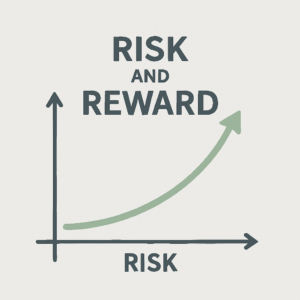
Risk and reward always travel together, but not symmetrically.
Larger rewards tend to require accepting greater uncertainty.
Smaller, safer choices usually deliver slower or more limited progress.
The mistake many people make is assuming that any large reward justifies any level of risk. In reality, intelligent decision-making is about proportionality.
The question is not whether risk exists. The question is whether the reward justifies this risk at this stage of life.
Everyday Examples of Risk Versus Reward
Let’s look at some clear examples to make this easier to grasp.
A Familiar Example: Credit and Interest Rates
People often feel that higher interest rates for financially stressed borrowers are unfair. Intuitively, it seems that lower rates would help more.
From the lender’s perspective, however, lending to someone with a history of missed payments carries greater uncertainty. Higher rates increase the lender’s potential reward to compensate for the risk.
This is not a moral judgement. It is a risk-management decision.
Seen this way, the system becomes easier to understand, even if it remains imperfect.
Risk and Reward Beyond Money
The idea of risk and reward isn’t only about money. It impacts your career, relationships, and health decisions too.
Career Choices
A higher-paying role may offer faster progression, but also longer hours, less flexibility, or reduced stability.
The reward is obvious.
The risk is often underestimated.
When both are acknowledged clearly, decisions become less emotionally charged and more aligned with long-term priorities.
Health and Lifestyle Changes
Trying a new training plan, diet, or routine can improve health and energy. It can also lead to injury, frustration, or burnout if poorly matched to your circumstances.
Understanding risk here does not discourage action. It encourages appropriate pacing and realistic expectations.
Why Ignoring Risk Is So Costly
Situations that promise high rewards with little or no downside deserve scrutiny.
Risk does not disappear when ignored. It simply remains unexamined until it surfaces as stress, loss, or regret.
Most major setbacks are not caused by taking risks. They are caused by taking risks without understanding them.
Financial Freedom Framework
FREE Framework Lens
In the FREE Framework, risk and reward sit most clearly in the Expansion phase, supported by Resilience.
Expansion is about choosing growth intentionally rather than drifting or reacting. Resilience ensures that progress does not come at the cost of stability.
When risk is aligned with clear goals and supported by fallback plans, progress becomes sustainable rather than stressful.
A Practical Way to Think About Risk and Reward
Before committing to an important decision, pause and ask:
What could realistically go wrong?
Focus on plausible outcomes, not worst-case fantasies.What does success actually look like?
Be precise about the reward you are pursuing.Is this risk appropriate for my current position?
Timing matters as much as ambition.What is my response if the outcome is disappointing?
Resilience is built through preparation, not optimism.
This approach replaces fear or bravado with clarity.
Risk Versus Reward: Final Reflection
Risk is not something to eliminate. It is something to select carefully.
Every meaningful improvement involves uncertainty. The difference between reckless moves and constructive progress lies in understanding the trade-off you are making.
Wise decisions are not about avoiding risk altogether. They are about choosing risks that support the life you are trying to build, at a pace you can sustain.
The most important question is not: “Is this risky?”
It is: “Is this risk worth it for me, right now?”